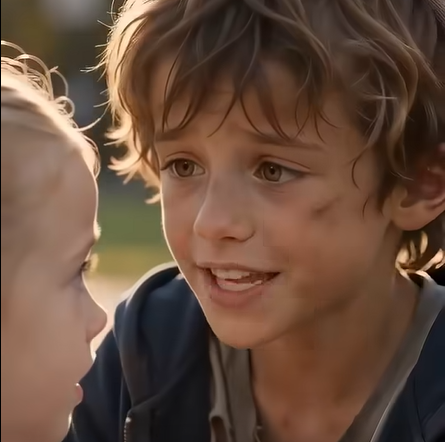
The silence around the pond felt heavier than the splash had been. The wealthy mother stood frozen, her expensive blazer soaked at the sleeves, her lips parted but unable to form a single word. A few minutes earlier, she had called the homeless boy filthy and pushed him away from her daughter’s world. Now that same little boy was kneeling on the grass, dripping wet, shivering, and gently checking if her daughter could breathe. He did not look angry. He did not ask for thanks. He only looked relieved that the little girl was safe.
The wealthy girl slowly reached for his hand. Her small fingers trembled as she held onto him, still scared from the water. The boy looked down, embarrassed, as if he was not used to anyone choosing to hold his hand. The girl whispered through tears, “You saved me.” The boy gave her a tiny, tired smile. “You were my friend,” he said softly. Those simple words broke something inside the mother. She realized her daughter had seen kindness where she had only seen poverty.
The mother took one step toward the boy, then stopped. Her pride, her judgment, and the cruel words she had thrown at him all came back at once. She looked at his torn hoodie, his muddy sneakers, the red mark on his cheek from her slap, and the way he still tried to hide his shaking hands. For the first time, she did not see a poor child near her daughter. She saw a lonely little boy who had been hurt by the world and still chose to save someone else.
Her voice cracked as she knelt in front of him on the wet grass, not caring that her designer clothes touched the ground. “I’m sorry,” she said, barely able to speak. The boy looked confused, as if he did not know adults could apologize to children like him. The mother covered her mouth, tears filling her eyes. “I was cruel to you. I was wrong. You protected my daughter when I had already hurt you.”
The boy lowered his gaze and whispered, “I just didn’t want her to be scared.” That answer made the mother cry harder. Behind them, the little girl wrapped her arms around the boy’s shoulders, not caring that his clothes were old, wet, and dirty. She hugged him like he was the bravest person in the park. The other parents who had stood silently nearby looked ashamed, realizing they had watched cruelty happen and done nothing until the boy acted.
The mother removed her expensive coat and gently placed it around the boy’s trembling shoulders. “Where is your family?” she asked softly. The boy hesitated, then shook his head. He did not need to explain much. His silence said enough. The mother looked at her daughter, then back at him, and something in her face changed completely. It was no longer shock. It was responsibility. “You are not invisible anymore,” she said. “Not to us.”
As the sun lowered behind the trees, the park slowly grew quiet again. The little girl stayed beside the boy, holding his hand, refusing to let go. The mother watched them with tears still on her face, understanding that wealth had not made her daughter safe — kindness had. That day, the homeless boy did more than save a child from the pond. He saved a mother from the cruelty inside her own heart. And from that moment on, the child she once rejected became the reason she finally learned what true humanity looked like.